

『Digital Flow Meter for Milk: Sanitary 3A Certified Dairy Processing Sensors』Related information(flow rotameter|digital flow meter|balo meter|hydraulic flow meter|volumetric meter|positive displacement meter|pitot tube flow meter|displacement meter|cfm meter|variable area flow meter|inline flow meter|differential pressure flow meter|calibrated flow meter|velocity meter|paddle wheel flow meter|oval gear flow meter|anemometer hvac|multiphase flow meter|doppler flow meter|thorpe tube flowmeter|heat flow meter)
Digital Flow Meter for Milk: Sanitary 3A Certified Dairy Processing Sensors
Quick Answer: A 3A certified electromagnetic flow meter with PFA liner, 316L stainless steel body, and Tri-Clamp connections covers most milk and dairy liquid measurement jobs. Silver Instruments supplies DN10 to DN100 sanitary electromagnetic and Coriolis mass flow meters with 4-20 mA HART, pulse, and Modbus RTU outputs. Send your flow range in kg/h or L/h, line size DN, and CIP temperature to Silver Automation Instruments for a specific model and price.
Why 3A Certification Changes the Sensor Design
A 3A certified sensor for milk must meet strict rules for cleanability and material contact. The wetted surface roughness should be 0.8 µm Ra or better. Small crevices trap milk residue and bacteria. That is why we use PFA liners and 316L stainless steel electrodes on electromagnetic meters. The process connections are Tri-Clamp, DIN 11851, SMS 1145, or IDF. Standard O-rings are EPDM or FKM in FDA approved grades.
In practice, most dairy engineers skip paint, exposed threads, and sharp internal corners. A sanitary flow meter should drain fully and withstand hot CIP cycles. Silver Instruments supplies meters with Ra 0.4 µm finish as an option for cream and infant formula lines.
Electromagnetic or Coriolis for Milk
Milk has a conductivity of 4000 to 8000 µS/cm, equal to 4 to 8 mS/cm. This range is high enough for a reliable electromagnetic flow meter signal. A magmeter has no moving parts and almost no pressure loss. For raw milk, pasteurized milk, skim milk, and whey, an electromagnetic meter is the lower cost choice.
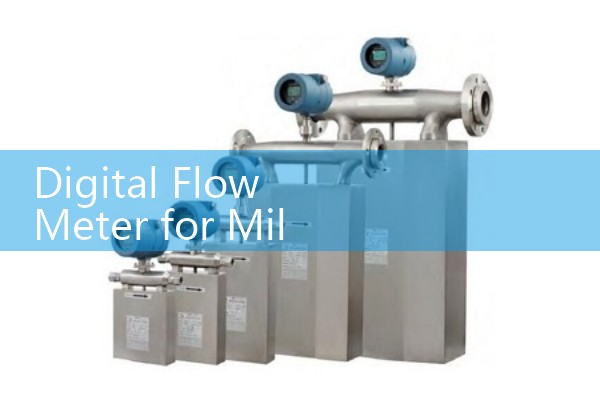
But Coriolis mass flow meters become the better option when the line handles cream, condensed milk, or high fat mixes. These liquids can have viscosity from 30 to 500 cP. A Coriolis meter gives true mass flow, density, and temperature. The pressure drop is higher and the price is higher, but the data is useful for dryer feed control and fat standardization.
Typical Flow Rates and Line Sizes
Dairy plants use different meter sizes depending on the process step. A DN25 meter handles separator feed of 2000 to 8000 L/h. A DN50 meter covers pasteurizer feed at 10000 to 25000 L/h. Raw milk intake often needs DN80 or DN100 for 30000 to 80000 L/h.
Electromagnetic meters for milk offer accuracy from 0.2 percent to 0.5 percent of rate. Coriolis meters offer 0.1 percent to 0.2 percent of rate with repeatability near 0.05 percent. Process temperature for standard models is 0 to 120°C. Hot CIP and SIP require up to 150°C rating.
Installation and CIP SIP Performance
Install the electromagnetic flow meter with 5D upstream and 2D downstream straight run. Use grounding rings if the pipeline is non-conductive. In dairy plants the pipe is usually 316L stainless steel, so standard grounding electrodes are enough.
Washdown areas need IP67 or IP68 remote electronics. The sensor must handle repeated thermal shock from hot caustic CIP and acid rinse
Output Options and Plant Integration
Standard outputs are 4-20 mA HART, pulse, and RS485 Modbus RTU. The 4-20 mA HART signal goes to a PLC or local batch controller. Pulse output works for dosing cultures, rennet, or cleaning chemicals in proportion to milk flow. Modbus RTU fits SCADA systems in larger dairy plants.
For batching operations, the flow meter can trigger a valve at a preset volume. Some customers use the empty pipe detection function to stop the pump when the milk tank runs dry. This protects the pump seal and prevents air from entering the pasteurizer.
Dairy Applications We Have Supplied
In 2024 a dairy plant in Vietnam asked for a DN80 electromagnetic flow meter for raw milk intake. The line ran at 40000 kg/h, 4 bar, 4°C. We supplied a 3A certified meter with Tri-Clamp connections, 4-20 mA HART, and IP67 remote display. The customer installed the meter in the receiving bay and connected it to the plant PLC.
A milk powder plant in New Zealand selected a DN25 Coriolis mass meter for cream feed to the dryer. The meter measured mass flow and density at 65°C. The density signal helped the operator adjust fat content before evaporation. This application used a 0.4 µm Ra finish and EPDM seals rated for 140°C.
FAQ
Q: Can an electromagnetic flow meter measure milk?
A: Yes. Milk conductivity ranges from 4000 to 8000 µS/cm. A sanitary electromagnetic meter with PFA liner and 316L stainless steel electrodes works for raw milk, pasteurized milk, skim milk, and whey.
Q: What process connections do you supply for dairy sensors?
A: We supply Tri-Clamp ISO 2852, DIN 11851, SMS 1145, IDF, and RJT connections. Tri-Clamp is the most common for milk plants. We also supply weld-on spuds for custom installations.
Q: What accuracy can I expect on milk flow measurement?
A: Electromagnetic meters give 0.2 percent to 0.5 percent of rate. Coriolis mass flow meters give 0.1 percent to 0.2 percent of rate. Repeatability is usually better than 0.1 percent.
Q: Does the meter survive hot CIP and SIP cycles?
A: Yes. Use PFA liner and EPDM or FKM seals rated for 150°C. Tell us your CIP temperature, acid concentration, and caustic concentration. We will match the liner and seal material to the cleaning regime.
Q: What information do you need for a milk flow meter quote?
A: Send your line size DN, flow range in kg/h or L/h, process temperature, CIP temperature, pressure in bar, connection type, and output signal. We will pick a model and send a quote with lead time and freight cost.
For a specific recommendation, contact Silver Automation Instruments. Tel +86-25-68650347, WhatsApp +86-25-52155837, WeChat +86 15365082610. Send us your milk flow range, pipe size DN, and CIP temperature. We will reply with a 3A certified sensor data sheet and a firm quotation.
 Hot News
 Related AD