

『Grout Flow Meter Sizing: Selecting Rugged Electromagnetic Sensors for High-Solid Civil Engineering Pumping』Related information(flow rotameter|digital flow meter|balo meter|hydraulic flow meter|volumetric meter|positive displacement meter|pitot tube flow meter|displacement meter|cfm meter|variable area flow meter|inline flow meter|differential pressure flow meter|calibrated flow meter|velocity meter|paddle wheel flow meter|oval gear flow meter|anemometer hvac|multiphase flow meter|doppler flow meter|thorpe tube flowmeter|heat flow meter)
Grout Flow Meter Sizing: Selecting Rugged Electromagnetic Sensors for High-Solid Civil Engineering Pumping
Quick Answer: For high-solid grout pumping, size the electromagnetic flow meter for a flow velocity between 1.5 and 4 m/s at peak flow. Select a polyurethane or hard rubber liner with tungsten carbide electrodes and install the sensor vertically with upward flow. Send Silver Instruments your flow range in m3/h, pressure in bar, temperature in degree C, and pipe size in DN for a firm quote.
Grout flow measurement is not the same as clean water metering. A standard electromagnetic flow meter with PTFE liner and stainless steel electrodes can fail within weeks on cement bentonite slurry. Solid particles coat the electrodes. The liner wears at the bends. Air slugs from piston pumps create false totals. Most engineers skip this part during initial sizing. Then the meter gets blamed for a bad grout take record.
We have seen this on customer sites many times. A foundation contractor in Malaysia ran a 12 m3/h grout line through a DN80 meter. The flow velocity was only 0.66 m/s. Cement solids settled on the electrode face. The reading drifted high by 12 percent after two weeks. We replaced the DN80 with a DN50 Silver Instruments SEF-G meter. The velocity came up to 1.7 m/s. The meter ran for eight months without coating or liner failure.
Why High-Solid Grout Needs Specific Meter Sizing
Electromagnetic flow meters measure conductive liquids with no moving parts. Cement grout, bentonite slurry, and microfine cement are conductive enough for a magmeter. Typical conductivity is between 500 and 5000 µS/cm. That is well above the 5 µS/cm minimum for the Silver Instruments SEF-G series.
The real problem is velocity. For high-solid grout, keep the flow velocity between 1.5 and 4 m/s. Below 1 m/s, solids settle and form a coating on the liner and electrodes. Above 5 m/s, the liner wears too fast and pump energy cost increases. Sizing is based on maximum grout flow, not just the pipe diameter.
The sizing math is simple. A DN50 meter at 10 m3/h gives about 1.4 m/s. A DN65 meter at 15 m3/h gives about 1.3 m/s. A DN80 meter at 20 m3/h gives about 1.1 m/s. For a 30 m3/h peak, a DN80 gives about 1.65 m/s. For a 60 m3/h peak, use a DN100 meter. Send the actual peak flow to Silver Instruments for a checked calculation. Many engineers give only the pipe size. That is not enough.
Liner and Electrode Selection for Abrasive Grout
Do not use PTFE liners on cement or sanded grout. PTFE is too soft for abrasive solids. Polyurethane and hard rubber are the two liner options we recommend. Polyurethane works well for pH 4 to 12 and fine cement grout. Hard rubber is best for cement bentonite slurries with sand or bentonite chips. Both liners have better abrasion resistance than PTFE.
Electrode selection matters just as much. Standard stainless steel electrodes can pit in chloride chemical grouts and wear in sanded grout. For high-solid civil engineering pumping, specify tungsten carbide electrodes on the SEF-G series. For chemical grouts with chloride, use Hastelloy C electrodes. The electrode tips sit flush with the liner to reduce solid build up and turbulence.
The SEF-G series comes in DN25 to DN300 flanged sizes. Pressure ratings are 10 bar and 16 bar. The temperature maximum is 80 degree C. The meter has built in empty pipe detection. This function is useful on piston grout pumps because air pockets cause false totals when the meter is not full.
Installation Rules on Civil Engineering Sites
Install the grout flow meter vertically with upward flow if possible. Upward
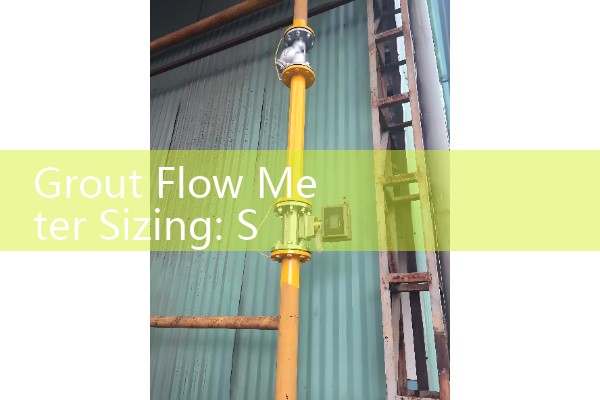
Grounding matters on grout lines. Electric driven piston pumps and welding generators on site create stray current. Use grounding rings on plastic pipes or a grounding electrode on flanged metal pipes. The SEF-G has a built in grounding electrode option for most sizes. If the pipeline has cathodic protection, use insulated grounding rings.
Keep a straight run of 5D upstream and 3D downstream. The reducer after a piston pump can create swirl. A straight run of 10D upstream gives a more stable reading. Do not install the meter on the suction side of the pump. Negative pressure can pull the liner inward and damage the sensor. For tunnel work with flooding risk, select the remote sensor with IP68 protection.
Signal Outputs and Remote Monitoring
Most grout plants need a 4-20 mA HART output for the PLC and a pulse output for totalizing grout volume. The pulse output supports cubic meter totalizers on the control panel. For tunnel and dam projects with remote telemetry, add RS485 Modbus RTU. The data goes directly to the site engineer without a local display.
Here is the thing. A grout flow meter is not only for flow confirmation. It is the record of grout take. On a dam foundation job in Latin America, the contractor used the pulse totalizer to prove grout volume to the owner. The owner accepted the SEF-G pulse record because it matched the batch plant weight within 1.5 percent.
Model Pairing for Common Grout Pump Ranges
For a 10 to 25 m3/h grout line, specify the Silver Instruments SEF-G DN50 with polyurethane liner, tungsten carbide electrodes, 4-20 mA HART plus pulse output. For a 20 to 50 m3/h grout line, specify the DN80 version with hard rubber liner and remote display if vibration is high. For a 35 to 80 m3/h peak, specify the DN100 version.
A typical part number is SEF-G-050-PU-TC-10-HART. This means DN50, polyurethane liner, tungsten carbide electrodes, 10 bar, and 4-20 mA HART plus pulse. Tell Silver Automation Instruments your flow range in m3/h, pressure in bar, temperature in degree C, and pipe size in DN. The application engineer will confirm the model code and lead time. Contact Tel: +86-25-68650347. Whatsapp: +86-25-52155837. WeChat: +86 15365082610.
FAQ
What size meter do I need for a grout pump at 5 to 20 m3/h? A DN50 meter handles 5 to 15 m3/h at 0.7 to 2.1 m/s. A DN80 meter is better for 20 m3/h at 1.1 m/s. Size for peak flow, not average flow.
Can I install the grout flow meter on a horizontal line? Yes, but keep the pipe full at all times. A horizontal install needs enough backpressure and no air release before the meter. Vertical upward flow is the first choice for high-solid slurry.
Which liner lasts longer on cement grout? Polyurethane and hard rubber both last longer than PTFE. Hard rubber is preferred for sanded grout and bentonite chips.
Does the meter read grout with air slugs? The SEF-G has empty pipe detection. If air slugs are frequent, the meter can hold the last value or output zero depending on the configuration. Air slugs mean the line is not full. Fix the plumbing first.
What output signals should I specify for a grout plant? Specify 4-20 mA HART for the PLC and pulse for totalizing. Add RS485 Modbus RTU for remote monitoring on tunnel or dam sites.
 Hot Product
 Related AD