

『Gasoline Flow Meter 10 L/min Calibration Span Tuning Steps』Related information(flow rotameter|digital flow meter|balo meter|hydraulic flow meter|volumetric meter|positive displacement meter|pitot tube flow meter|displacement meter|cfm meter|variable area flow meter|inline flow meter|differential pressure flow meter|calibrated flow meter|velocity meter|paddle wheel flow meter|oval gear flow meter|anemometer hvac|multiphase flow meter|doppler flow meter|thorpe tube flowmeter|heat flow meter)
Gasoline Flow Meter 10 L/min Calibration Span Tuning Steps
Quick Answer: A gasoline flow meter with a 10 L/min range needs span calibration when the output drifts beyond the datasheet accuracy. At Silver Automation Instruments, we tune the 4-20 mA span by injecting a known gasoline volume at full scale and adjusting the digital trim until the reading matches the reference. This ensures your dispenser or test bench meets custody transfer requirements or batch control tolerances.
Before You Start the Span Tuning
Every calibration job starts with a clean meter and stable gasoline. Gasoline viscosity is about 0.6 cP at 20°C. That is thinner than water. Small particles from tank rust or pump wear can jam oval gear flow meters or turbine bearings. Flush the line with clean gasoline and install a 100-mesh strainer just upstream. Wire the flow meter according to its wiring diagram. For a turbine meter with a 4-20 mA + pulse output, you need a 24 V DC loop supply, a multimeter in series, and a pulse counter. If the meter has a HART protocol, connect the HART communicator across the loop.
Let the gasoline temperature stabilize. A shift of 5°C changes the volume by about 0.5% on typical hydrocarbons. For a 10 L/min meter used in a fuel testing rig in Thailand or a lubricant blending station in Mexico, we recommend at least 15 minutes of circulation at target flow. In practice, most engineers skip the warm-up step and then wonder why the zero shifts. Do not skip this part.
Setting the Zero Point Properly
Span tuning means nothing if the zero is off. Close the downstream isolation valve while the meter body is full of gasoline. Ensure no trapped air. Wait until the flow reading on the display or PLC settles. A typical Silver Instruments turbine meter with a PT100 temperature sensor and smart transmitter can show a residual flow of 0.2 to 0.5 L/min when the line is truly shut. That is normal crosstalk, not a leak. Some operators force a zero with a push-button. But here is the thing: a forced zero on a positive displacement meter can mask a real gear wear issue. We have seen this on customer sites in Nigeria where the meter kept under-reporting after a push-button zero because one lobe was scratched.
If your transmitter has a digital user interface, navigate to the zero trim function. Let it average 20 readings. Record the offset. If the physical zero is more than 1% of the 10 L/min span, fix the mechanical issue before touching the span.
The Actual Span Tuning for a 10 L/min Gasoline Flow Meter
Span tuning is the process of matching the 20 mA point to a known 10.00 L/min flow. Bring the flow to exactly 10 L/min. Use a reference standard. That can be a coriolis mass flow meter on a calibration rig, a master meter, or a volumetric prover. A paint manufacturer in Southeast Asia told us they used a calibrated bucket and stopwatch. That introduces operator error and gasoline vapors. Do not use that method for a meter that will be used in trade.
Once your reference confirms 10.00 L/min, look at the transmitter output. If it reads 20.15 mA, the span is wide. You need to trim it down. Access the span trim via the local display or HART. Enter the exact reference value, for example, 10.00 L/min, and apply. The transmitter recalculates the gain. Then drop the flow to 5 L/min and check linearity. The output should be 12.00 mA. If it is 12.25 mA at mid-scale, the meter may have a linearity error beyond the sensor’s specification. A typical turbine meter for gasoline handles a linearity of ±1% of reading from 1 to 10 L/min. A positive displace
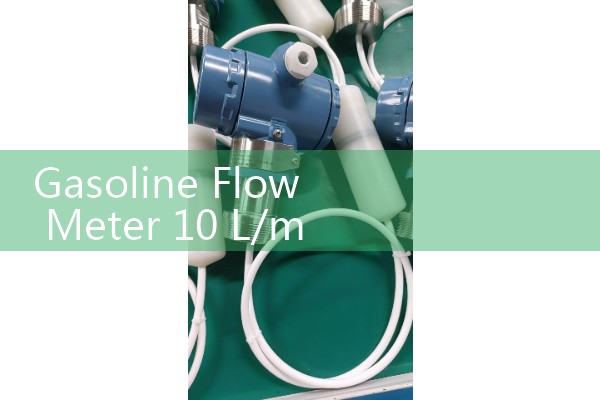
For a meter with an ATEX Zone 1 certification, do the span tuning with the cover closed if the area is classified. Use a HART barrier and a certified calibrator. We often ship our meters with a calibration certificate showing the 10 L/min point, the gasoline density at test, and the meter factor.
Checking the Tuned Span under Process Conditions
After the adjustment, cycle the flow from 2 to 10 L/min and back. Write down the readings at 6, 8, and 10 L/min. The worst error should be inside the accuracy band. If you need a max error of 0.2% for a custody transfer setup in a Middle East depot, a single-point span tuning may not be enough. You might need a multi-point calibration. But for a standard gasoline transfer skid or engine test bench in Australia, a well-done 10 L/min span tuning keeps everything within 0.5%.
If you see spikes in the 4-20 mA signal, check for electrical noise. Gasoline is a low-conductivity fluid. Static buildup can happen on turbine blades. Use a meter with a grounding ring or a conductive liner to bleed off the static. Silver Instruments offers options with PTFE lining and tantalum electrodes designed for hydrocarbon services.
Recommendations from the Silver Instruments Team
We often get calls from field technicians saying the span tune will not hold. The issue is usually a faulty coupling or a bent turbine shaft. Inspect the rotor visually. Any wobble at 10 L/min destroys repeatability. Also, keep a calibration logbook. For a 10 L/min gasoline meter on a truck loading rack, schedule a span check every 100,000 liters or monthly. Over time, gasoline detergents can coat internal parts and change the flow profile.
Send us your pressure (bar), temperature range (°C), pipe size (DN), and gasoline flow range (L/min). We will recommend a suitable meter and provide a span tuning procedure for your exact model. Our support engineers in Perth, Dubai, and Santiago handle these requests daily.
FAQ: Span Tuning Gasoline Flow Meters
Can I tune the span for a 10 L/min gasoline meter without a reference flow standard?
No. You need a known volume or mass. A master meter is the minimum. A bucket and stopwatch will not catch the dynamic errors that matter at 10 L/min.
What causes the span to drift on an oval gear gasoline meter?
Mechanical wear, dirty gasoline, and thermal expansion of the gears. If the meter runs dry for too long, the gears gall and change the displacement volume per revolution.
Why does my 4-20 mA output jump after span tuning?
Likely an open ground or a loop supply voltage drop. Also, if the meter has a pulse safety barrier, check that it is rated for the signal frequency at 10 L/min.
Which Silver Instruments meter works best for 10 L/min gasoline?
We recommend our oval gear flow meter series with a stainless steel body and FKM seals for gasoline. Add a pulse amplifier or a 4-20 mA transmitter. For custody transfer, see our turbine flow meter with a dual-channel pickup.
How often should I do a span tuning?
For continuous gasoline metering, check the span every 30 days. For batch processes, verify it before each production run. The environment in Vietnam or Saudi Arabia, with high humidity and dust, demands more frequent checks.
 Hot Product
 Related AD