

 Current position > Product detail
『Tig Welding Flow Meter: Shielding Gas Flow rate Optimization』Related information(flow rotameter|digital flow meter|balo meter|hydraulic flow meter|volumetric meter|positive displacement meter|pitot tube flow meter|displacement meter|cfm meter|variable area flow meter|inline flow meter|differential pressure flow meter|calibrated flow meter|velocity meter|paddle wheel flow meter|oval gear flow meter|anemometer hvac|multiphase flow meter|doppler flow meter|thorpe tube flowmeter|heat flow meter)
Tig Welding Flow Meter: Shielding Gas Flow Rate Optimization
Quick Answer: For TIG welding, a shielding gas flow rate of 7 to 12 liters per minute (L/min) covers most manual jobs on steel and stainless steel. Cup size, joint geometry, and draft conditions shift this number. A flow meter with a calibrated scale and a sturdy body gives you repeatable settings and fewer gas-related weld defects.
Real shops do not guess gas flow. They dial in a number and trust the flow meter. On a stainless pipe spool in a Singapore fabrication yard last year, a welder showed me his argon bottle. He had a basic regulator with a floating ball tube. The ball bounced all over the place. His weld had grey soot at the edges. A proper TIG welding flow meter with a needle valve stopped that. Gas flow sat steady at 9 L/min. Colour came back clean.
A TIG welding flow meter controls shielding gas delivery from the cylinder to the torch cup. It lets you set the exact flow rate. Argon, helium, and argon-CO2 blends all behave differently through the same meter. Argon is dense. A meter calibrated for argon will read about 1.4 times higher if you push helium through it without adjusting. Many shops in the Middle East run pure argon. In that case, a dedicated argon flow meter tube avoids that conversion error.
What Is a TIG Welding Flow Meter
A TIG welding flow meter is a device that measures and controls shielding gas flow rate. It usually combines a pressure regulator, a flow tube or digital sensor, and a needle valve. The regulator drops cylinder pressure from 200 bar down to 3 to 5 bar. The flow tube gives a visual float reading in L/min or CFH. The needle valve fine-tunes the actual flow. Some units now have a digital display with a 4-20 mA output, but most welding shops use simple mechanical meters because they survive a drop from a workbench.
There are two main types. One is the floating ball or variable area flow meter. You read the flow against a scale printed on a plastic or glass tube. The other is a thermal mass flow meter built into some orbital TIG power sources. The thermal version works well in automated tube welding for food and pharma pipework. Silver Automation Instruments supplies both styles. A small dairy processor in New Zealand asked us for a flow meter for their orbital TIG setup on 316L tubing. They needed repeatable flow at 8 L/min with argon-hydrogen mix. A thermal mass meter with a 4-20 mA signal tied directly into the weld controller.
Why Flow Rate Optimization Matters
Too little gas lets oxygen into the weld pool. You see porosity, dark oxide colours, and reduced corrosion resistance on stainless steel. Too much gas creates turbulence. It pulls in ambient air and can chill the tungsten. The arc becomes unstable. Welders in Brazil we worked with told us they used to crank argon to 20 L/min thinking more was better. They burned through bottles fast and still got pinholes. A simple flow meter set to 10 L/min gave them a clean shield and cut gas costs by 30 percent.
Material and joint type set the baseline flow. A butt weld on a flat plate uses less gas than a fillet weld on a corner. An open root pipe joint needs extra purge and sometimes a different torch angle. All these factors push you to adjust flow. A flow meter with a sharp needle valve makes that adjustment easy. Without it, you are turning a regulator knob and hoping.
How to Optimize Your Shielding Gas Flow Rate
Start with the cup size. A simple rule many welders follow: Flow rate in L/min equals cup diameter in millimetres. A number 8 cup is about 12.5 mm inside diameter. Set flow around 8 to 10 L/min. That rule works for argon on mild steel and stainless. For aluminium with AC TIG, use a slightly higher flow because the arc wanders and needs a wider shield. Go up 2 to 4 L/min.
Check the weld appearance. A shiny stainless bead (gold to light blue) tells you the gas cover was right. A dark grey or black bead means you lost shieldin
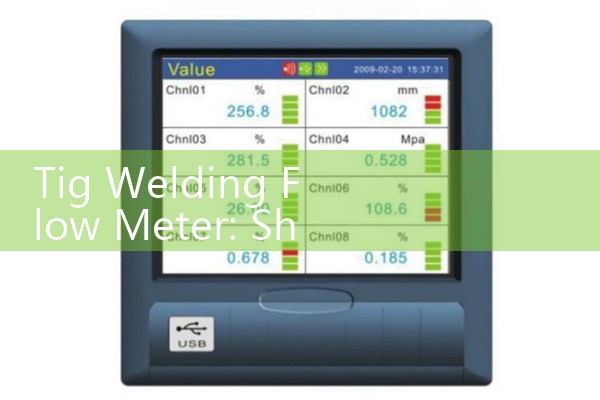
Gas lens versus standard collet body. A gas lens creates a laminar flow column. It lets you extend the tungsten stickout and use lower flow rates. With a gas lens, you can often run 6 L/min where a standard collet needs 10 L/min. This is useful in tight spots such as pipe welds inside a chemical plant rack. The flow meter stays the same. The technique changes.
Common Gas Flow Problems and Solutions
Drafts from fans or open bays disrupt the gas shield. We have seen this many times on customer sites. In a workshop in Thailand with large ceiling fans, the welders built small barriers around the joint. Flow was bumped from 10 to 14 L/min. The flow meter was a 0-25 L/min floating ball type. The added flow overcame the draft without wasting too much gas.
Leaks in the gas line. A tiny leak after the flow meter wastes gas and can pull air into the hose when the solenoid closes. Spray a soapy water mix on connections. Fix leaks before adjusting the flow meter. A flow meter will not fix a leaky system.
Pre-flow and post-flow settings. These are usually set on the TIG power source, not the flow meter. But they affect how much gas covers the tungsten before and after the arc. A short post-flow of 2 to 5 seconds per 100 amps cools the tungsten. Set the flow meter for steady-state flow. The machine handles the short bursts.
A Quick Field Calibration Check
You can check a mechanical flow meters accuracy with a portable gas flow calibrator. Most shops do not own one. A simple check: connect two flow meters in series on the same gas line. Compare readings at 5, 10, 15 L/min. If the meters disagree by more than 10 percent, replace or recalibrate the tube. Silver Instruments flow meters ship with a calibration certificate traceable to national standards. A fabrication yard in Lagos ordered ten units for their argon manifold. Each meter showed less than 5 percent deviation across the batch.
FAQ — Shielding Gas Flow Rate for TIG Welding
Q: What is the best flow rate for TIG welding stainless steel?
A: 8 to 12 L/min of argon using a cup size 8 to 10. Adjust based on joint type and draft.
Q: Can I use a general-purpose gas regulator instead of a TIG flow meter?
A: A regulator shows pressure, not flow. You cannot set a repeatable L/min without a flow meter. A flow meter or flow gauge is standard for any gas-shielded process.
Q: Does the flow reading change when the gas cylinder pressure drops?
A: A good flow meter with a balanced regulator holds steady flow until the cylinder is nearly empty. If your float bounces when cylinder pressure changes, upgrade to a flow meter with a better regulator section.
Q: How do I choose between a floating ball meter and a thermal mass meter?
A: A floating ball meter works for manual TIG in a shop. A thermal mass meter is for automated orbital TIG or data logging. It outputs a 4-20 mA signal. Silver Instruments can quote both types.
Q: Where can I buy a TIG welding flow meter with factory calibration?
A: Silver Automation Instruments supplies calibrated flow meters for argon, helium, and mixed shielding gases. Shipping to Southeast Asia, Oceania, Africa, and the Middle East is available. Send us your gas type, required flow range (L/min), and connection thread size (BSP or NPT) to [email protected]. We prepare a quote within one working day.
Get a flow meter that fits your gas and your shop environment. Tell us your gas type, flow range, and whether you need a bench mount or panel mount. Contact Silver Automation Instruments [email protected] | Tel: +86-25-68650347 | Whatsapp: +86-25-52155837 | WeChat: +86 15365082610. Fast shipping to Vietnam, Indonesia, Thailand, Australia, UAE, Saudi Arabia, South Africa, Brazil, and more.